

The top news stories from Latin America
Provided by AGP
Restriction enzymes market seen reaching $411.4M by 2033
May 12, 2026
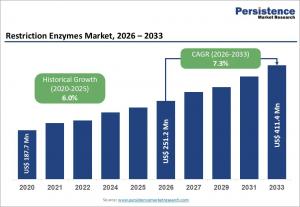
By AI, Created 4:21 PM UTC, May 18, 2026, /AGP/ – Persistence Market Research says the global restriction enzymes market will grow from $251.2 million in 2026 to $411.4 million by 2033, driven by cloning, sequencing prep, molecular diagnostics and mRNA manufacturing. North America leads today, while Asia Pacific is projected to grow fastest as biotech investment and genomics research expand.
Why it matters: - Restriction enzymes remain a core tool in molecular biology, diagnostics and biomanufacturing. - The market’s growth signals rising demand for DNA manipulation, sequencing workflows and GMP-grade reagents in regulated research and production settings. - The shift toward mRNA therapeutics, precision medicine and epigenetics is widening use beyond traditional cloning.
What happened: - Persistence Market Research projects the global restriction enzymes market will reach US$251.2 million in 2026 and US$411.4 million by 2033. - The forecast implies a 7.3% compound annual growth rate from 2026 to 2033. - The report was published May 12, 2026. - The market is being driven by demand for cloning, plasmid linearization, sequencing library preparation and molecular diagnostics.
The details: - Type II restriction enzymes hold the largest share of laboratory use and are projected to account for 41.6% of the market. - Cloning applications represent about 39.2% of total usage. - North America is projected to hold 40.8% of global market share. - Asia Pacific is expected to be the fastest-growing region because of biotech investment, genomics research and pharmaceutical manufacturing in China, India and Japan. - Academic and research institutes account for 46.8% of end-user demand. - Biotechnology and pharmaceutical companies are the fastest-growing end-user segment. - Type II enzymes such as EcoRI and HindIII remain common in cloning, plasmid mapping and gene expression studies. - Type IV enzymes are the fastest-growing product segment because of methylation-sensitive DNA analysis and epigenetics research. - Cloning remains the leading application because of its role in recombinant DNA technology, gene expression studies and plasmid construction. - Sequencing, PCR and restriction fragment length polymorphism are also listed as major applications. - The market includes Type I, Type III and other enzyme categories.
Between the lines: - The report points to a market that is still anchored in standard lab workflows but moving toward higher-value regulated uses. - mRNA production and advanced biomanufacturing are increasing demand for high-purity, animal-free and GMP-compliant enzymes. - Newer DNA assembly methods such as seamless cloning, Gibson Assembly and enzyme-free approaches are pressuring some traditional restriction-enzyme use cases. - Regulatory complexity and stricter formulation requirements raise manufacturing costs and can slow adoption for smaller labs. - The competitive field remains fragmented, with Thermo Fisher Scientific, New England Biolabs and Promega Corporation among the named players. - Promega’s partnerships with Watchmaker Genomics and EditCo Bio are part of broader efforts to advance RNA analysis, cell-based research and next-generation sequencing tools.
What’s next: - Demand is likely to rise as epigenetics, molecular diagnostics, RNA therapeutics and sequencing workflows expand. - Asia Pacific’s research infrastructure and government support may make the region a bigger production and consumption hub. - Companies are expected to keep investing in enzyme innovation, GMP-grade production and regional supply-chain expansion. - The report also offers a free sample, customization options and a full report purchase link: Download the free sample, request customization, and checkout the complete report.
Disclaimer: This article was produced by AGP Wire with the assistance of artificial intelligence based on original source content and has been refined to improve clarity, structure, and readability. This content is provided on an “as is” basis. While care has been taken in its preparation, it may contain inaccuracies or omissions, and readers should consult the original source and independently verify key information where appropriate. This content is for informational purposes only and does not constitute legal, financial, investment, or other professional advice.
Sign up for:
Latin American Newswire
The daily local news briefing you can trust. Every day. Subscribe now.
Check Your Email!
We sent a one-time activation link to: .
Confirm it's you by clicking the email link.
If the email is not in your inbox, check spam or try again.
Welcome back!
is already signed up. Check your inbox for updates.