
Zero Liquid Discharge Market to Reach US$ 12.9 Billion by 2032, Growing at an 8.1% CAGR | Persistence Market Research
Zero Liquid Discharge Market Size and Trends Analysis
Global Zero Liquid Discharge Market set to grow rapidly, driven by water scarcity, sustainability initiatives, and advanced treatment technologies.
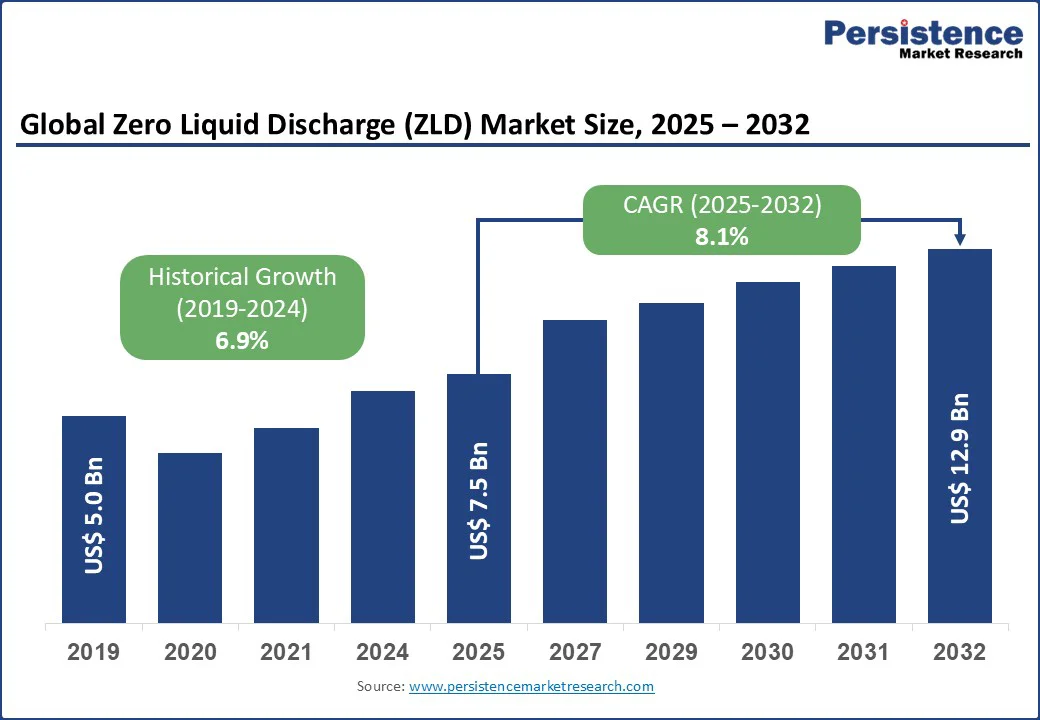
BRENTFORD, LONDON, UNITED KINGDOM, March 31, 2026 /EINPresswire.com/ -- The global zero liquid discharge (ZLD) market is gaining significant traction as industries and municipalities increasingly focus on water conservation, regulatory compliance, and sustainable wastewater management. According to leading market research firms, the market is projected to be valued at US$ 7.5 billion in 2025 and is expected to reach US$ 12.9 billion by 2032, registering a robust compound annual growth rate (CAGR) of 8.1% between 2025 and 2032.
Zero liquid discharge systems are engineered to minimize wastewater discharge from industrial processes by recovering and reusing water while concentrating and safely managing solids. These systems find application across multiple industries, including power generation, chemicals, pharmaceuticals, textiles, oil & gas, and food & beverages. The rising focus on environmental sustainability, coupled with stringent government regulations on wastewater discharge, is accelerating market adoption.
Get Free Sample Now: https://www.persistencemarketresearch.com/samples/12307
Key Highlights from the Report
➤ The global zero liquid discharge market is projected to grow from US$ 7.5 billion in 2025 to US$ 12.9 billion by 2032, at a CAGR of 8.1%.
➤ Power generation, chemical, and pharmaceutical industries are the primary adopters of ZLD solutions due to strict regulatory mandates.
➤ Asia-Pacific dominates the market, driven by industrial expansion and rising environmental regulations in countries like India and China.
➤ Increasing freshwater scarcity and the push for sustainable industrial operations are major growth drivers.
➤ Technological innovations such as AI-based monitoring, IoT-enabled process control, and advanced membrane systems are enhancing operational efficiency.
➤ North America is witnessing steady growth due to the adoption of advanced ZLD technologies and retrofitting of existing wastewater treatment plants.
Market Segmentation
By System Type
• Zero Liquid Discharge (ZLD)
• Minimal Liquid Discharge (MLD)
By Application
• Power Generation
• Oil & Gas
• Chemicals & Petrochemicals
• Metals, Mining & Minerals
• Pharmaceuticals
• Food & Beverages
• Textiles & Leather
• Paper & Pulp
• Others (Electronic & Semiconductor, etc.)
By Region
• North America
• Europe
• East Asia
• South Asia and Oceania
• Latin America
• Middle East and Africa
Request For Customization: https://www.persistencemarketresearch.com/request-customization/12307
Regional Insights
Asia-Pacific leads the ZLD market, accounting for the largest share, due to rapid industrialization, growing water scarcity, and strict environmental regulations in countries like China and India. Industries across the region are investing in ZLD solutions to ensure compliance with governmental discharge norms and reduce operational water costs.
North America and Europe are mature markets, with growth driven by retrofitting existing wastewater treatment facilities and adopting advanced membrane-based solutions. The Middle East is witnessing steady growth due to water-scarce conditions and increasing investment in desalination and industrial water reuse projects.
The fastest-growing region is Asia-Pacific, where governmental initiatives promoting sustainable industrial operations, coupled with rising freshwater scarcity, are accelerating the adoption of ZLD systems across multiple sectors.
Unique Features and Innovations in the Market
Modern ZLD solutions are differentiated by their integration of advanced technologies to enhance water recovery, reduce energy consumption, and improve operational efficiency. Evaporation crystallizers now employ energy-efficient mechanical vapor recompression, while membrane-based systems leverage high-rejection reverse osmosis membranes for optimal water recovery.
AI and IoT are playing a pivotal role in transforming ZLD operations. Intelligent monitoring systems can predict fouling, scaling, or membrane failures and adjust operational parameters automatically. These innovations not only reduce operational costs but also extend the lifespan of critical components.
Furthermore, 5G-enabled connectivity in ZLD systems allows real-time data transmission to cloud platforms, enabling predictive analytics, remote diagnostics, and centralized monitoring across industrial sites. This integration improves decision-making, ensures compliance, and enhances overall system efficiency.
Market Highlights
Industries are adopting ZLD solutions to achieve regulatory compliance, water cost savings, and sustainability goals. Environmental regulations mandating near-zero discharge of industrial effluents are a primary driver, particularly in power, chemical, and textile sectors.
Cost reduction through water reuse and recovery is another key factor influencing adoption. By minimizing freshwater intake and reducing effluent disposal costs, industries improve operational efficiency while supporting sustainability initiatives.
Corporate sustainability commitments and ESG (Environmental, Social, and Governance) mandates are further fueling demand, as companies strive to reduce their water footprint and demonstrate responsible resource management.
Key Players and Competitive Landscape
The global ZLD market is highly competitive, with major players focusing on technological innovation, regional expansion, and strategic partnerships.
✦ Veolia Water Technologies – Leading provider of advanced ZLD systems with a focus on energy-efficient evaporators and membrane solutions.
✦ SUEZ Water Technologies & Solutions – Offers integrated ZLD solutions with AI-enabled monitoring for optimized water recovery and treatment efficiency.
✦ GE Water & Process Technologies – Specializes in membrane-based ZLD systems and retrofitting solutions for industrial wastewater treatment.
✦ Aquatech International – Focuses on turnkey ZLD systems for high-salinity wastewater, with expertise in chemical and power sectors.
✦ IDE Technologies – Provides energy-efficient ZLD and desalination solutions, particularly for industrial and municipal applications.
✦ Doosan Heavy Industries & Construction – Offers integrated ZLD and evaporator-based systems with a strong presence in Asia-Pacific markets.
These companies leverage R&D, technological innovation, and strategic alliances to expand their global footprint and meet evolving industrial water management requirements.
Buy Now: https://www.persistencemarketresearch.com/checkout/12307
Future Opportunities and Growth Prospects
The zero liquid discharge market is expected to witness robust growth through 2032 due to increasing water scarcity, rising industrialization, and stringent environmental regulations. Emerging technologies such as AI-based automation, IoT-enabled monitoring, and energy-efficient membrane systems present significant opportunities for differentiation and enhanced operational efficiency.
The adoption of ZLD solutions is likely to expand across developing economies where industrial water demand is rising rapidly, and freshwater resources are under stress. Corporate sustainability initiatives and government incentives promoting efficient water reuse are expected to further drive market expansion.
As industries increasingly recognize water as a critical resource and regulatory frameworks become stricter, the ZLD market is positioned to grow steadily, providing sustainable, cost-effective, and technologically advanced solutions for industrial water management worldwide.
Explore the Latest Trending Research Reports:
• Pipeline Maintenance Service Market
• Industrial Noise Control Market
Persistence Market Research
Persistence Market Research Pvt Ltd
+1 646-878-6329
email us here
Visit us on social media:
LinkedIn
Instagram
Facebook
YouTube
X
Legal Disclaimer:
EIN Presswire provides this news content "as is" without warranty of any kind. We do not accept any responsibility or liability for the accuracy, content, images, videos, licenses, completeness, legality, or reliability of the information contained in this article. If you have any complaints or copyright issues related to this article, kindly contact the author above.
